
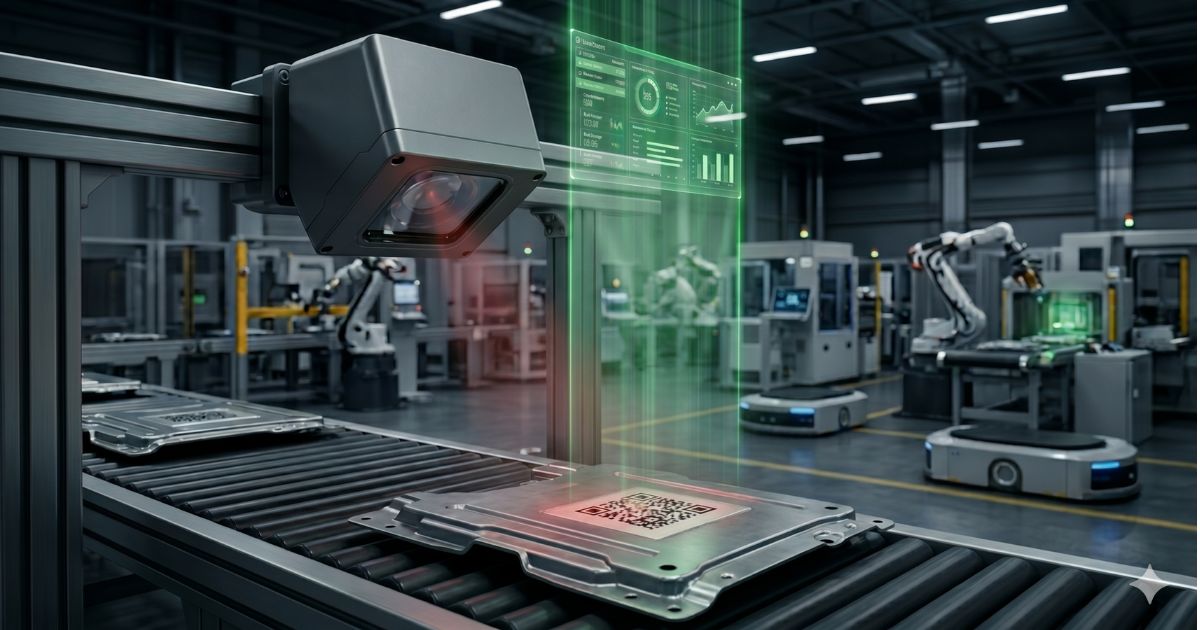
How Industry 4.0 Is Reshaping Barcode Scanning on the Factory Floor
What Does Industry 4.0 Actually Mean for Your Scanning Setup?
For most of its history, barcode scanning on the factory floor was a human activity: a worker picks up a device, aims it at a label, and presses a trigger. The data gets recorded. That model still exists, and in many operations it still makes sense. But the fourth industrial revolution ??Industry 4.0 ??is creating a new category of scanning requirements that the traditional handheld-and-trigger model was never designed to handle.
The global industrial barcode scanner market was valued at approximately USD 4.0 billion in 2025 and is projected to reach USD 9.0 billion by 2035, growing at a CAGR of 8.3%, according to Future Market Insights data. A significant portion of that growth is being driven by the shift toward automated, connected manufacturing environments. Understanding what's changing ??and why ??is essential for any operation planning scanner investments in the next two to three years.
What Is Industry 4.0 and Why Does It Change Scanning Requirements?
Industry 4.0 refers to the integration of digital technologies into manufacturing: the Industrial Internet of Things (IIoT), cloud computing, real-time data exchange, AI-driven analytics, and increasing levels of automation. The core idea is that machines, systems, and people are continuously exchanging data in a connected ecosystem ??and decisions are made based on that data in real time, not after the fact.
In this model, barcode scanning is no longer just a data entry tool. It becomes a data input node in a larger connected system. Every scan generates a data point that flows into manufacturing execution systems (MES), enterprise resource planning (ERP) platforms, quality control workflows, and supply chain visibility systems. The requirements this places on scanning hardware are meaningfully different from what a traditional handheld scanner needs to deliver.
What changes specifically
Three shifts in particular drive the new requirements. First, speed: Industry 4.0 production lines often run faster than humans can reliably scan. Conveyor speeds, robotic handling cycles, and automated transfer systems operate at rates where triggering a scan manually creates a bottleneck ??or simply isn't feasible. Second, integration: data from a scan needs to reach the right system in real time, not be uploaded at the end of a shift. This demands direct network connectivity and structured data output that can interface with MES and ERP platforms. Third, traceability: in regulated industries and quality-focused manufacturing, every component, sub-assembly, and finished product needs a documented scan history. This level of traceability requires more than a periodic manual scan ??it requires a scan at every defined process checkpoint, consistently and without human-dependent reliability.
From Manual Handheld to Fixed-Mount Automation
The clearest expression of Industry 4.0 scanning is the fixed-mount scanner. Instead of a worker holding a device and aiming it at items, the scanner is mounted in a fixed position and items pass through its read zone ??on a conveyor, through a gate, or at a robotic transfer point. The scanner reads automatically, without triggering, without any human involvement.
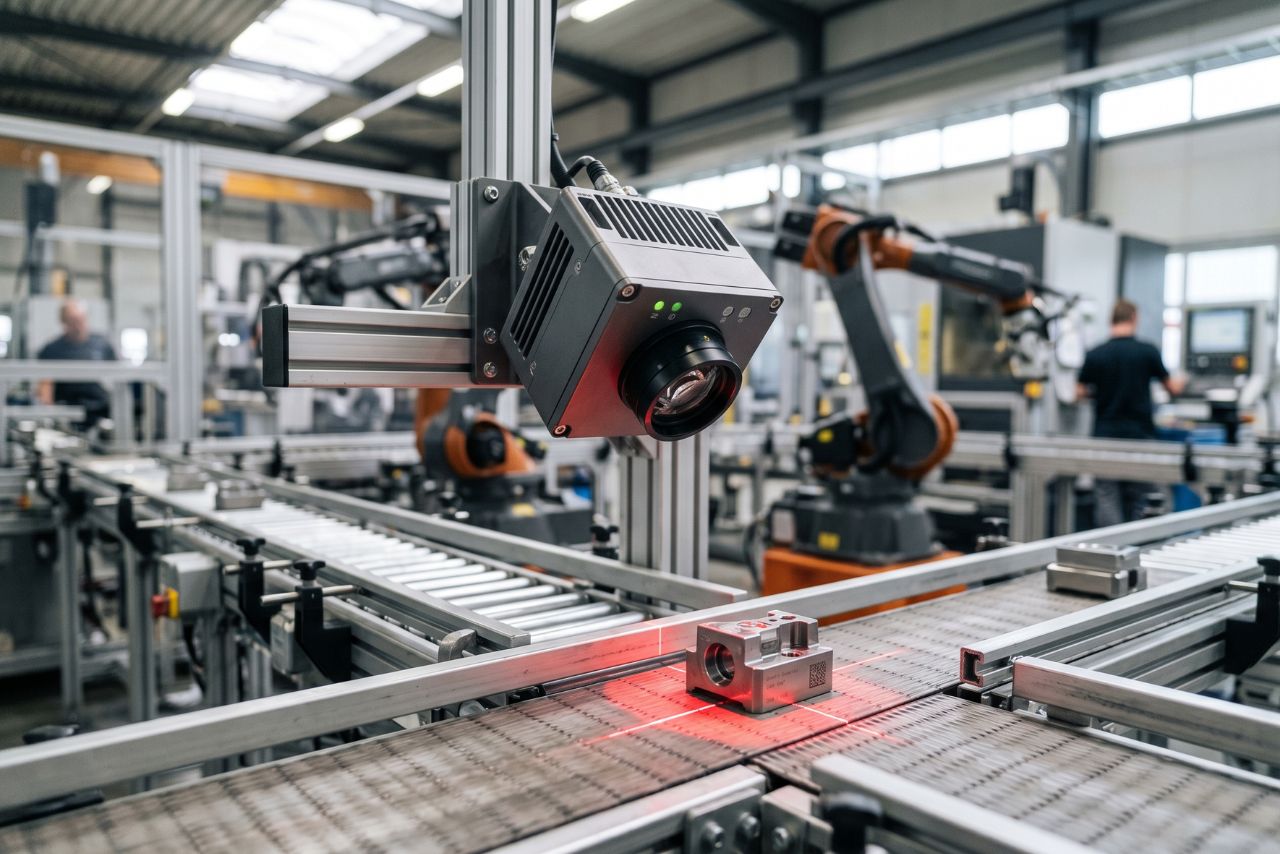
Trigger-based fixed-mount
The scanner is activated by a sensor ??a photoelectric eye, a proximity detector, or a signal from the PLC ??when an item enters the read zone. This is the most common approach for conveyor scanning: reliable, deterministic, and easy to integrate with standard industrial control systems.
Portal scanning
Items pass through a tunnel or portal with multiple scanners positioned at different angles. This approach is used when items arrive in unpredictable orientations and a single scanner can't guarantee a read from every angle. Common in shipping sortation, receiving portals, and mixed-SKU handling environments.
Machine vision and camera-based systems
As scanning requirements become more complex ??reading multiple codes simultaneously, reading codes on curved or irregular surfaces, capturing image data alongside code data ??traditional laser scanners are increasingly being supplemented or replaced by camera-based imaging systems. These systems can decode multiple symbologies from a single image, maintain a visual record of each read, and handle code types and positions that defeat traditional scanners. The camera-based readers segment is expected to see the fastest growth in industrial scanning markets through 2032, according to Data Bridge Market Research data.
Direct Part Marking: When the Label Can't Be a Label
In automotive, aerospace, electronics, and medical device manufacturing, the traceability requirement extends to individual components ??not just cartons or pallets. The problem with labeling individual components is that labels don't survive the manufacturing process. They get painted over, damaged by heat treatment, abraded by handling, or simply fall off in harsh environments.
Direct Part Marking (DPM) is the solution: a barcode is permanently marked directly onto the part surface using laser etching, dot-peening, ink-jet printing, or chemical etching. The code becomes part of the component and survives the entire manufacturing and service life of the part.
Why DPM changes the scanner requirement
DPM codes are significantly harder to read than printed labels. The contrast between the code and the surface is lower, the code may be on a curved or reflective surface, and the marking method affects the geometric regularity of the dots or cells. A standard laser scanner or basic 2D imager will fail on DPM codes that a purpose-designed DPM reader handles without difficulty.
DPM-capable readers use specific illumination techniques ??typically high-angle ring lighting or dome lighting ??to maximize contrast on low-contrast surfaces, combined with image processing algorithms optimized for the distortions introduced by different marking methods. If your manufacturing process generates DPM codes, confirm that any scanner you specify includes certified DPM capability, not just general 2D imaging.
Where DPM is mandatory
Automotive: component traceability from manufacture to end-of-life is increasingly required by OEM standards and regulatory frameworks. Aerospace: parts traceability is required under aviation authority regulations in most jurisdictions. Medical devices: FDA and equivalent regulatory bodies require unique device identification (UDI) on medical devices, often implemented via DPM. Electronics: PCB and component-level traceability in high-reliability electronics manufacturing.
Real-Time Traceability: Connecting the Scan to the System
Industry 4.0 manufacturing doesn't just want to know what was scanned at the end of the day. It wants to know what was scanned at each step, in real time, with the data immediately available to the systems that need it.
Work-in-process (WIP) tracking
As a component moves through production stages ??machining, assembly, testing, finishing, packaging ??a scan at each station creates a time-stamped record of that component's journey. If a quality issue is found downstream, the scan history pinpoints exactly which stations processed the affected unit, what parameters were in use at the time, and what other units were processed in the same batch. This traceability capability is what enables the kind of targeted recalls and quality investigations that would have taken weeks to execute with paper records.
Manufacturing execution system (MES) integration
The scan is only as useful as what happens to the data after it's read. In an Industry 4.0 environment, the scanner output goes directly into the MES, which can trigger the next step in the production workflow, flag an exception if the scanned component doesn't match the expected sequence, update inventory in real time, or generate a quality hold. This requires the scanner to output structured data in a format the MES can consume, which means the integration approach ??keyboard wedge, SDK, API, or PLC protocol ??needs to be specified alongside the scanner hardware.
What Industry 4.0 Demands From Your Scanner Hardware
The aggregate of these shifts produces a specific set of hardware requirements for Industry 4.0 scanning applications:
Decode speed: production lines won't slow down for a scanner. Industrial fixed-mount readers need to decode reliably at line speed, which may mean reading codes on items moving at 1??+ meters per second.
Connection to industrial networks: direct Ethernet, OPC-UA, or Profinet connectivity for integration with PLCs and MES platforms, not just Wi-Fi for WMS communication.
DPM capability: if your product or component carries a direct part mark, the scanner must be DPM-certified. General 2D imaging is not sufficient.
IP65 minimum, IP67 preferred: factory environments involve coolant, cutting fluid, dust from machining, and regular cleaning. Environmental sealing appropriate to the actual floor conditions is non-negotiable.
Wide temperature range: some manufacturing environments involve significant temperature variation ??not just the nominal range, but thermal shock when moving between zones.
Image capture capability: the ability to save a photograph of each scan provides audit evidence and enables visual quality verification alongside data capture, increasingly required in regulated industries.
Is Your Current Scanning Setup Ready?
A useful framework for assessing readiness: work through your production process and identify every point where a scan needs to happen. For each point, ask: is this scan currently manual or automated? What system does the data go to, and how quickly? What happens if the scan fails or is missed? Is the code on a label or directly on the part?
The answers identify the gaps. Manual scans at high-speed transfer points are a throughput bottleneck. Scans that batch-upload at shift end are an integration gap. Components with direct marks that can't be reliably read by current hardware are a traceability gap. Each of these gaps has a hardware and integration solution ??but the solution needs to be matched to the specific requirement, not selected generically.
Explore our Product Range to find industrial scanning hardware designed for automated manufacturing environments and Industry 4.0 integration requirements.
Are manual scanning bottlenecks impacting your production TCO? Transitioning to Industry 4.0 requires more than just hardware; it demands strategic MES integration and DPM expertise. ALVICS provides rugged, fixed-mount scanning solutions and technical consulting to ensure your factory achieves real-time traceability and zero-defect compliance.
to evaluate your production line and request a tailored deployment strategy.